C:\Documents and Settings\Administrator\My Documents\memory game\first game\first game.html
(the game)
http://www.education.vic.gov.au/languagesonline/games/memory/ (the original site)
Tuesday, April 5, 2011

Tuesday, March 29, 2011
Tuesday, October 12, 2010
Material for your Written Assignmenst
HI people! Hope you had a great long weekend to rest and catch up with life. I uploaded a new folder in our box called "Written Assignments", the link is as follows:
http://www.box.net/shared/eed518x1mu
I also recommend you read the comments I placed on each individual upload since all the files have a differnt purpose and use.
Raad them for 2morrow and we will continue working on it.
C U, Julie.
http://www.box.net/shared/eed518x1mu
I also recommend you read the comments I placed on each individual upload since all the files have a differnt purpose and use.
Raad them for 2morrow and we will continue working on it.
C U, Julie.
Tuesday, October 5, 2010
Very interesting web info to check out
Please have this info with you at school tomorrow. It is VERY insightful in terms of the implications it carries with it.
http://www.thesmokinggun.com/documents/bizarre/justice-department-seeks-ebonics-experts
You should also download this worksheet (in the language folder in the box) called Language Variety. This is the link. It is not long, so please have it done.
http://www.box.net/shared/0ecdphmo0m
C U 2morrow, Julie.
http://www.thesmokinggun.com/documents/bizarre/justice-department-seeks-ebonics-experts
You should also download this worksheet (in the language folder in the box) called Language Variety. This is the link. It is not long, so please have it done.
http://www.box.net/shared/0ecdphmo0m
C U 2morrow, Julie.
Monday, September 27, 2010
Clear version of map
this is the link that will take you to the new and improved digital version of the map. I typed the text again after the original map.
by the way, you also had to print and work with German Canale's text. Please bring it to class. See you on Wednesday.
Julie.
http://www.box.net/shared/jya3k27odr
by the way, you also had to print and work with German Canale's text. Please bring it to class. See you on Wednesday.
Julie.
http://www.box.net/shared/jya3k27odr
Sunday, September 12, 2010
English as a Global Language
I've uploaded a new doc for you to work on in class this Wednesday or Thursday. Make sure you have a copy of it and read the instructions that are on the comment in the box file. These questions are different from those in the pdf. Don't forget to read or print them as well.
http://www.box.net/shared/781s0smazo
C U later gaters!
Julie.
http://www.box.net/shared/781s0smazo
C U later gaters!
Julie.
Friday, September 10, 2010
Interviews
HI everybody, these are the links to the wav files of both interviews. Please listen to them and take comments to class in temrs of how your perception of the person behind the voice. Do the different accents affect what you think of these people? How would you describe them based on this element of analysis? (accent)
http://www.box.net/shared/7kv9yo5k8c
Well, have a nice weekend and see you on Monday.
Julie
http://www.box.net/shared/7kv9yo5k8c
Well, have a nice weekend and see you on Monday.
Julie
Wednesday, September 1, 2010
Character Attribute Web (C.A.W.)
HI! this is the link that will take you to the web we worked with in class. Remember that besides bearing in mind what is on the diagram for your analysis, it would be wise to also take into account what OTHER characters and the narrator say about your subject.
http://www.box.net/shared/i38734bh2x
See you 2morrow.
http://www.box.net/shared/i38734bh2x
See you 2morrow.
Sunday, August 29, 2010
Essay proposals
Hi people! this link will take you to a selection of the essay proposals (paper 2) that are related to character development or character analysis.
We will be analizing them in class 2morrow, so if you can, check them out.
c u Julie.
http://www.box.net/shared/n3xh7jt6hg
We will be analizing them in class 2morrow, so if you can, check them out.
c u Julie.
http://www.box.net/shared/n3xh7jt6hg
Thursday, August 26, 2010
Bazalgette
At the time, the
The system was opened by Edward, Prince of Wales in 1865, although the whole project was not actually completed for another ten years.
Bazalgette's foresight may be seen in the diameter of the sewers. When planning the network he took the densest population, gave every person the most generous allowance of sewage production and came up with a diameter of pipe needed. He then said 'Well, we're only going to do this once and there's always the unforeseen.' and doubled the diameter to be used. Every Londoner should be grateful for this foresight as the then unforeseen was the tower block. If he had used his original, smaller pipe diameter the sewer would have overflowed in the 1960s. As it is they are still in use to this day.
http://en.wikipedia.org/wiki/Joseph_Bazalgette#Sewer_works


Elizabeth Barrett Browning
Elizabeth Barrett Browning (6 March 1806 – 29 June 1861) was one of the most prominent poets of the Victorian era.
Elizabeth Barrett Moulton Barrett was born on 6 March 1806, in Coxhoe Hall, between the villages of Coxhoe and Kelloe in County Durham, England. Her parents were Edward Barrett Moulton Barrett and Mary Graham Clarke; Elizabeth was the eldest of their 12 children (eight boys and four girls). All the children lived to adulthood except for one girl, who died at the age of four when Elizabeth was eight. The children in her family all had nicknames: Elizabeth's was "Ba". The Barrett family, some of whom were part Creole, had lived for centuries in Jamaica, where they owned sugar plantations and relied on slave labour. Elizabeth's father chose to raise his family in England while his fortune grew in Jamaica. The Graham Clarke family wealth, also derived in part from slave labour, was also considerable.
Elizabeth was baptized in 1809 at Kelloe Parish Church, though she had already been baptized by a family friend in the first week after she was born. Later that year, after the fifth child, Henrietta, was born, their father bought Hope End, a 500-acre (2.0 km2) estate near the Malvern Hills in Ledbury, Herefordshire. Elizabeth had "a large room to herself, with stained glass in the window, and she loved the garden where she tended white roses in a special arbour by the south wall"[2] Her time at Hope End would inspire her in later life to write Aurora Leigh. She was educated at home and attended lessons with her brother's tutor. This gave her a good education for a girl of that time; she read passages from Paradise Lost and Shakespearean plays, among other works, before the age of ten. During the Hope End period, she was an intensely studious, precocious child.[3] Her intellectual fascination with the classics and metaphysics was balanced by a religious intensity which she later described as "not the deep persuasion of the mild Christian but the wild visions of an enthusiast." [4][5] The Barretts attended services at the nearest Dissenting chapel, and Edward was active in Bible and Missionary societies. Elizabeth was very close to her siblings and had great respect for her father: she claimed that life was no fun without him, and her mother agreed, probably because they did not fully understand what the business really was that kept him when his trips got longer and longer.
Wednesday, August 18, 2010
Interesting information on themes, motifs and symbolism
You might have already received the box notice. In case you couldn't see it, this is the link that will take you there.
http://www.box.net/shared/2c4jgxl5gc
See you 2morrow. Julie.
http://www.box.net/shared/2c4jgxl5gc
See you 2morrow. Julie.
Tuesday, August 17, 2010

Why Did People Enter the Workhouse?
People ended-up in the workhouse for a variety of reasons. Usually, it was because they were too poor, old or ill to support themselves. This may have resulted from such things as a lack of work during periods of high unemployment, or someone having no family willing or able to provide care for them when they became elderly or sick. Unmarried pregnant women were often disowned by their families and the workhouse was the only place they could go during and after the birth of their child. Prior to the establishment of public mental asylums in the mid-nineteenth century (and in some cases even after that), the mentally ill and mentally handicapped poor were often consigned to the workhouse. Workhouses, though, were never prisons, and entry into them was generally a voluntary although often painful decision. It also carried with it a change in legal status — until 1918, receipt of poor relief meant a loss of the right to vote.
The operation of workhouses, and life and conditions inside them, varied over the centuries in the light of current legislation and economic and social conditions. The aims of many pre-1834 workhouses are well expressed in this 1776 sign above the door of Rollesby workhouse in Norfolk:

The emphasis in earlier times was more towards the relief of destitution rather than deterrence of idleness which characterized many of the institutions set up under the 1834 Poor Law Amendment Act.
Entering the Workhouse
Whatever the regime inside the workhouse, entering it would have been a distressing experience. New inmates would often have already been through a period of severe hardship. It was for good reason that the entrance to the Birmingham union workhouse was through an arch locally known as the "Archway of Tears".

The Admission Procedure
Admission into the workhouse first required an interview to establish the applicant's circumstances. This was most often undertaken by a Relieving Officer who would visit each part of the union on a regular basis. However, the workhouse Master could also interview anyone in urgent need of relief.
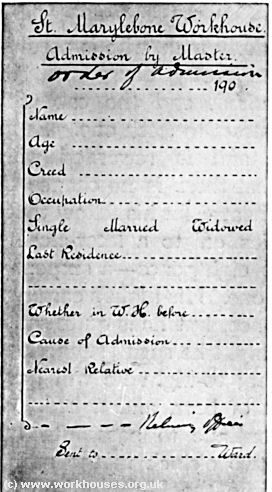

Prior to their formal admission into the main workhouse, new arrivals would be placed in a receiving or probationary ward. There the workhouse medical officer would examine them to check on their state of health. Those suffering from any infectious illness would be placed in a sick ward.


Leaving the Workhouse
While residing in a workhouse, paupers were not allowed out without permission. Short-term absence could be granted for various reasons, such as a parent attending their child's baptism, or to visit a sick or dying relative. Able-bodied inmates could also be allowed out to seek work. Although there was often little to physically prevent a pauper from walking out of the workhouse, to do so without permission would result in a charge of the theft of union property — his workhouse uniform. Any pauper could, however, on giving "reasonable notice" — typically three hours — discharge himself from the workhouse. His clothes would then be fetched from the store and more administrative paperwork would need to be completed. In the case of a man with a family, the whole family would have to leave if he left.
Despite the lengthy admission and discharge procedures, some paupers treated the workhouse as a free lodging, leaving and departing as the fancy took them. It was not unknown for a pauper to discharge himself in the morning and then return demanding re-admission the same evening, possibly the worse for wear from drink. In 1901, one 81-year-old woman named Julia Blumsun recorded 163 separate admissions to the City of London workhouse, while a 40-year-old man in the Poplar workhouse had been in and out 593 times over the period since 1884. These were the most extreme examples of what became known as the "ins-and-outs". Because of the amount of time they took to deal with, became the bane of the workhouse staff's life. Eventually, in the early 1900s, new regulations were introduced to lengthen the amount of notice required depending on how recently an inmate had previously discharged himself.
Perhaps a more typical example of the ins-and-outs is provided by seven-year-old Charlie Chaplin who in 1896 briefly became an inmate of the Lambeth union workhouse, together with his mother, Hannah, and his older half-brother Sydney. After a three-week probationary period, the two children were then transferred to the Central London District School at Hanwell. Two months later, the children were returned to the workhouse where they were met at the gate by Hannah, dressed in her own clothes. In desperation to see them, she had discharged herself from the workhouse, along with the children. After a day spent playing in Kennington park and visiting a coffee-shop, they returned to the workhouse and had to go through the whole admissions procedure once more, with the children again staying there for a probationary period before returning to Hanwell.
Many inmates were, however, to become long-term residents of the workhouse. A Parliamentary report of 1861 found that, nation-wide, over 20 percent of inmates had been in the workhouse for more than five years. These were mostly consisted of elderly, chronically sick, and mentally ill paupers. Fifteen inmates in the survey had been workhouse residents for sixty years or more. Institutionalization of inmates, particularly women, was something that was to continue right until the end of the workhouse era. In the past few years, whilst visiting a number of former workhouses that now operate as care homes for the elderly, I have been told on two separate occasions that one of the establishment's current residents had been there since the 1920s.
Thursday, August 12, 2010
Punch magazine! 2


Note: Michael Faraday (22 September 1791 – 25 August 1867) was an English chemist and physicist (or natural philosopher, in the terminology of the time) who contributed to the fields of electromagnetism and electrochemistry. (From the wikipedia entry)

Punch magazine!
The first edition of Punch was published on July 17, 1841, four years after Queen Victoria came to the throne. Its founders, wood engraver Ebenezer Landells and writer Henry Mayhew, got the idea for the magazine from a satirical French paper, Charivari (indeed, the first issue was subtitled, "The London Charivari").

The magazine was set up with capital of £25… and the future soon looked bleak. The circulation refused to rise, money ran short and it began to look as if Lemon would have the same success with Punch as he did with his previous enterprise, a pub which went bankrupt.
But then he had the bright idea of publishing a big annual issue called the Almanack which sold an astonishing 90,000 copies and Punch was on the map. In the medium term, however, it continued to struggle for survival until it was taken over by the printing firm of Bradbury and Evans (which became Bradbury and Agnew in 1872).
The magazine then entered its golden age, a period in which it enjoyed great success for decades. When a magazine becomes identified with a period it very often fails to survive it. The readers of the Strand Magazine in Edwardian days, or of Life between the wars or of Picture Post just after, would have been unable to imagine those household names ever vanishing, yet vanished they have.So what was the secret of Punch's survival?
More than anything, it was its ability to find the wavelength of an age. Even in Victorian days Punch did not stand still. In its early years, the years of the Chartists and the unrest that swept through Europe in 1848, it was radical. The most famous example of this was Thomas Hood's "Song of the Shirt", which moved people's consciences over sweated labour. But by the 1860s it had become milder, less inclined to attack the Establishment or support the underdog, and this too was in tune with the rising middle class and the feeling that the British Empire had come to stay.
A succession of superb artists on Punch ensured that the manner in which it played safe was brilliant. The drawings of Leech, Keene, du Maurier, Tenniel and many only slightly lesser men may not have prompted any revolutions or moves to man the barricades, but they still represent the most authentic and memorable picture of Victorian England that we have left. And it is forgotten that Punch was one among many humorous magazines in the nineteenth century it was not even, in fact, the only one called Punch.
It was, however, the only one of the breed that continued to flourish for another hundred years, almost as if it was a national institution that could not be allowed to die. This status as a part of British history is a source both of great pride and huge annoyance to Punch, a millstone as well as a medal.
Each time Punch has made a significant advance in tune with the times - when Malcolm Muggeridge introduced a sharper, more acid note, when Bernard Hollowood finally abandoned the old cover, when William Davis engineered such coups as a full-scale parody of Playboy - critics have grumbled that this isn't how a national institution should behave.

A promotional booklet produced in 1974 was full of confidence for the future: "It has found new security within a large organisation and an added confidence to combat the gloom of the 1970s with cheerfulness, humour and even optimism." By the late Eighties, however, circulation had dropped to an alarmingly low level and three editors in three years failed to arrest the decline. Punch was eventually closed by United in 1992 and it looked like the end for a title which had become loved around the world.
Salvation came in the form of Harrods proprietor, Mohamed Al Fayed, who relaunched the magazine with a glittering party at Harrods in September 1996. The magazine soon positioned itself as a thorn in the side of the Establishment, with a series of irreverent exposes. These included Murdoch by his butler, the most intimate look yet at the world's leading media mogul, and The Mandelson Files, a mouldbreaking investigation into Peter Mandelson, then the most feared member of the New Labour government.
Sadly, the magazine failed to regain its place in the hearts of the British public and closed again in 2002, leaving a legacy of over 160 years of humour and wit unsurpassed in publishing history.The pictures shown are those of the first and the last number of the magazine.

London Expo 1851
The Great Exhibition of the Works of Industry of all Nations or The Great Exhibition, sometimes referred to as the Crystal Palace Exhibition in reference to the temporary structure in which it was held, was an international exhibition that took place in Hyde Park, London, from 1 May to 15 October 1851. It was the first in a series of World's Fair exhibitions of culture and industry that were to become a popular 19th-century feature. The Great Exhibition was organized by Henry Cole and Prince Albert of Saxe-Coburg and Gotha, the spouse of the reigning monarch, Victoria. It was attended by numerous notable figures of the time, including Charles Darwin, members of the Orléanist Royal Family and the writers Charlotte Brontë, Lewis Carroll, and George Eliot
Official title: The Great Exhibition of the Works of Industry of All Nations
Exhibition site: Hyde Park
Area: 10.5 hectares, of which 7.2 hectares for the Crystal Palace
Exhibition area: 8.7 hectares
Duration: 1 May – 11 October 1851
Exhibitors: 14,000 with over one million exhibits, 6,900 from England
Foreign participants: from 25 countries and 15 British colonies
Visitors: 6,039,205
Entrance fees: variable, between one shilling and
one pound
Classification: 4 sections and 30 classes
Jury: 314 members, half from England, half foreign
Prizes: 5,130 awards in three categories. Awards of the first category go mainly to Britain (46 percent) and France (33 percent)
Cost: 913,000 pounds
Profit: 150,000 pounds
Official title: The Great Exhibition of the Works of Industry of All Nations
Exhibition site: Hyde Park
Area: 10.5 hectares, of which 7.2 hectares for the Crystal Palace
Exhibition area: 8.7 hectares
Duration: 1 May – 11 October 1851
Exhibitors: 14,000 with over one million exhibits, 6,900 from England
Foreign participants: from 25 countries and 15 British colonies
Visitors: 6,039,205
Entrance fees: variable, between one shilling and
one pound
Classification: 4 sections and 30 classes
Jury: 314 members, half from England, half foreign
Prizes: 5,130 awards in three categories. Awards of the first category go mainly to Britain (46 percent) and France (33 percent)
Cost: 913,000 pounds
Profit: 150,000 pounds
Subscribe to:
Posts (Atom)
